
Why this distinction matters more today than ever
By Bijan Golkar
There is a comparison I have heard countless times throughout my career.
“Investing is just another form of gambling.”
Most of the time, it is said casually. Sometimes it is said half-jokingly after a rough market stretch. And to be fair, I understand where it comes from. Markets move. Outcomes are uncertain. There are no guarantees. If you zoom in close enough, it can feel unpredictable.
But that is where the comparison should stop.
While investing and gambling may share uncertainty, they are fundamentally different in what you are actually doing with your money.
This article was inspired by a recent piece from Schwab Asset Management, which does a great job highlighting the distinction between investing and gambling.
At its core, investing is about ownership.
When you invest, you are buying a piece of a business (individual stocks) or, more often, a collection of businesses (ETFs/Mutual Funds). Those companies generate revenue, employ people, create products, and evolve over time. Your investment is tied to something real, something that has the potential to grow and compound – this is a very different dynamic from placing a bet.
With gambling, there is no ownership. There is no underlying asset quietly working in your favor over time. Odds drive the outcome, and those odds are not designed to benefit you in the long run.
That difference is easy to overlook in the moment, but it becomes very clear over time.
What has truly changed in recent years is not the definition of investing or gambling, but rather how simple it has become to engage in both, particularly gambling.
Sports betting, prediction markets, and online platforms have made it incredibly accessible. What used to take effort now takes seconds. It lives on your phone. It is integrated into live sports. It is constantly in front of you.
What makes this shift even more striking is the data behind it.
Prediction markets and betting activity have grown rapidly, not just in dollars, but in the number of transactions and users participating. This is no longer a niche trend. It is becoming part of everyday financial behavior, particularly for younger generations.
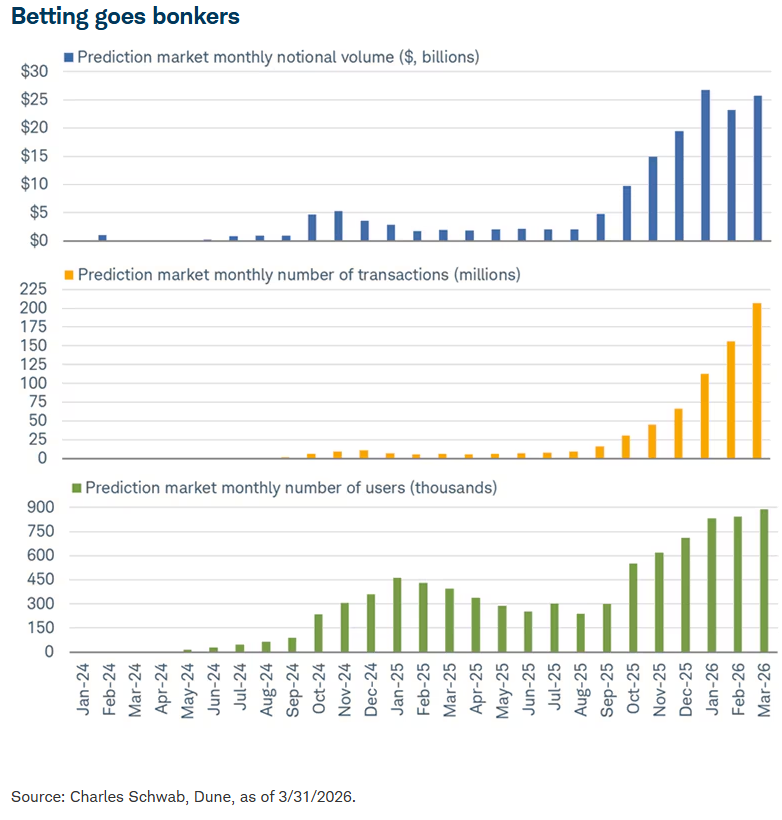
When you step back and look at this level of growth, it reinforces an important point. This is not just about entertainment anymore. It is becoming a habit.
And that is where I start to see it show up in real life.
I have spoken with people who regularly set aside a portion of their paycheck—money that has already been taxed—and use it for sports betting. Not just occasionally, but as a habit.
This is a very different mindset from investing.
There is nothing inherently wrong with gambling (in moderation, of course). The problem arises when it begins to feel like a strategy, or even worse, a replacement for building wealth.
This shift was partly sped up by the pandemic, as more people stayed home and markets became volatile. Social media was flooded with stories of quick profits and large gains, with entire communities engaging in trading, speculation, and short-term strategies. Gradually, the distinctions between investing, trading, and gambling became less clear, exemplified by communities like r/WallStreetBets.
As a result, patience became harder to hold on to. Saving felt sluggish. Discipline seemed less satisfying. Long-term plans seemed to require too much waiting, especially when everything else offered instant gratification.
However, this is precisely where investing proves most effective. Accumulating wealth has never really been about speed.
It is about consistency. It is about making thoughtful decisions over time and giving those decisions the space to grow.

The better analogy is not a winning bet. It is planting something early and continuing to take care of it. At first, it does not look like much. Progress feels slow. But over time, something starts to take shape. Eventually, that growth becomes meaningful. That is the essence of compounding returns.
While it may not be exciting day-to-day, it is precisely this consistency that makes investing so effective over the long term. Clients who have been with us for over 20 years still find it remarkable when they see the true power of compounding at work.
For many of our clients, this conversation is not really about them – it is about their children and grandchildren.
We are seeing a generation grow up in an environment where financial decisions are increasingly gamified. Risk is constant. Outcomes are immediate. And money is often associated with quick results rather than long-term progress.
Financial habits are not something people figure out later. They are built early. If someone grows up associating money with constant action and short-term wins, it becomes much harder to develop the discipline required for long-term investing. That is why these conversations matter.
These discussions do not need to be complicated. In many cases, they are best when simple – showing kids how saving works, letting them see progress over time, and helping them understand that not every dollar needs to be spent or risked.
There is a meaningful difference between putting your money into something designed to grow over time and putting your money into something designed, statistically, for you to lose. As Schwab Asset Management highlights, “UC San Diego Rady School of Management studied more than 700,000 online gamblers over five years through 2023, tracking digital payment records across 32 states. Researchers found that fewer than 5% of online sports gamblers have withdrawn more money from their gambling apps than they deposited. Let’s flip that sentence: More than 95% of participants are net losers over time. This is not a feature of bad luck or poor timing—it is the mathematical inevitability built into these products by design.”
That reality is not theoretical – it plays out over time.
That difference matters. It matters for your future. It matters for your family. It matters for the next generation.
If you have not yet had this conversation with your children or grandchildren, it is worth starting.
Financial habits do not develop on their own. They are taught, observed, and reinforced over time.
For many families, knowing where to begin or how to frame these conversations can be the hardest part. If you would like help thinking through how to approach this with your children or grandchildren, please give us a call.
Attribution
This article was inspired by a recent piece from Schwab Asset Management
Schwab Asset Management – Gambler’s Blues: Betting Isn’t Investing